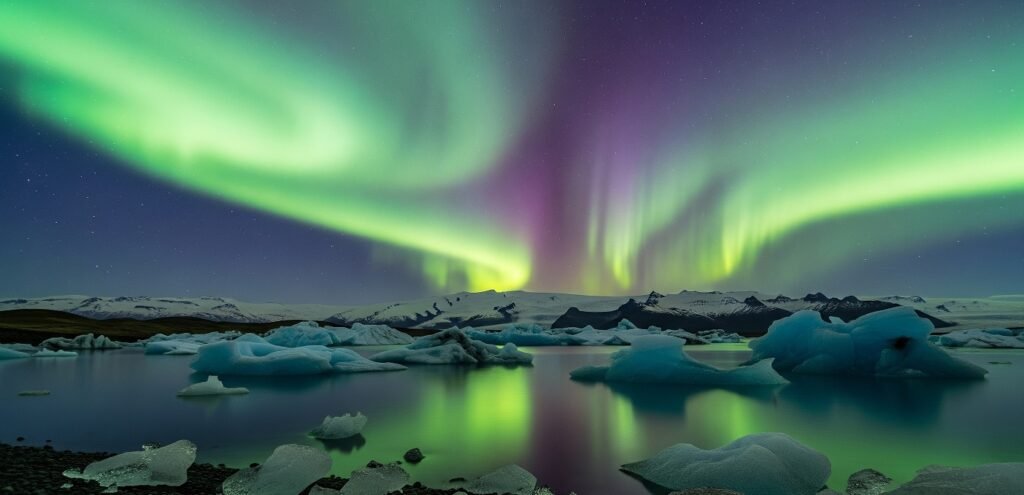
Key Points – Northern Lights in Iceland
- Prime Viewing Location: Research suggests Iceland offers some of the world’s best opportunities to witness the Aurora Borealis due to its high latitude, minimal light pollution in rural areas, and frequent clear winter skies, though sightings are never guaranteed and depend on solar activity.
- Optimal Timing: The evidence leans toward September through April as the ideal period, with peak chances in winter months when nights are longest, but increased cloud cover from climate change may complicate visibility in some years.
- Viewing Challenges and Rewards: It seems likely that avoiding urban light pollution by heading to remote spots enhances experiences, while tours provide guidance; however, tourism growth has sparked debates on sustainability, balancing economic benefits with environmental preservation.
- Cultural and Scientific Appeal: The Northern Lights hold deep cultural significance in Icelandic folklore, often tied to myths of elves or ancestors, and scientifically result from solar particles interacting with Earth’s atmosphere, with ongoing discussions about how solar cycles outweigh climate impacts on their occurrence.
Northern Lights in Iceland: Understanding the Phenomenon
The Northern Lights, or Aurora Borealis, are a natural light display caused by charged particles from the Sun colliding with Earth’s atmospheric gases, exciting them to emit colourful glows primarily green from oxygen, with reds and blues from higher altitudes or nitrogen. In Iceland, this spectacle is amplified by the country’s position under the auroral oval, making it accessible without extreme polar travel. However, visibility requires dark, clear nights, low light pollution, and active solar winds, often peaking during the 11-year solar cycle’s maximum, expected around 2025.
Planning Your Trip
Start by monitoring forecasts via sites like the Icelandic Met Office for aurora activity (Kp-index above 2) and cloud cover. Dress in layers for sub-zero temperatures, and consider guided tours for safety, especially in winter. Popular spots include Jökulsárlón Glacier Lagoon and the Snæfellsnes Peninsula, where dramatic landscapes frame the lights. For accommodations, opt for remote hotels with wake-up alerts, like Hotel Rangá.
Tips for Capture and Enjoyment
Photography enthusiasts should use a tripod, a wide-angle lens (f/2.8), and settings like ISO 1600 with 10-15 second exposures to capture the dynamic colours. Be patient, lights may dance for hours or appear briefly. Respect local culture by exploring myths, such as the aurora as dancing elves, adding a layer of wonder. Sustainable practices, like sticking to paths, help mitigate tourism’s environmental footprint.
Chasing the Aurora: A Comprehensive Guide to the Northern Lights in Iceland
The Northern Lights, or Aurora Borealis, have captivated humanity for centuries, weaving threads of mystery, science, and folklore into the fabric of night skies across the polar regions. In Iceland, this ethereal display transforms the island’s rugged landscapes into a living canvas of swirling greens, purples, and reds, a phenomenon that draws millions of visitors each year.
As one of the most accessible destinations for aurora hunting, Iceland offers a unique blend of natural beauty, cultural depth, and adventure. But chasing the lights is as much an art as it is a science, requiring preparation, patience, and a touch of luck. This article delves deeply into every aspect of experiencing the Northern Lights in Iceland, from the underlying physics to practical travel tips, cultural myths, and the broader implications of tourism and climate change. Whether you’re a first-time visitor or a seasoned aurora chaser, you’ll find insights to enhance your journey.
The Science Behind the Spectacle: How the Northern Lights Form
At its core, the Aurora Borealis is a cosmic ballet orchestrated by the Sun, Earth’s magnetic field, and atmospheric chemistry. The process begins 93 million miles away on the Sun’s surface, where solar flares and coronal mass ejections (CMEs) hurl charged particles, mostly electrons and protons, into space at speeds up to 2 million miles per hour. These particles form the solar wind, a constant stream that interacts with Earth’s magnetosphere, the protective bubble shaped by our planet’s molten iron core.
When solar activity intensifies during geomagnetic storms, magnetic reconnection occurs: the solar wind’s magnetic fields link with Earth’s and then snap, accelerating particles along field lines toward the poles. As these particles plunge into the upper atmosphere at altitudes of 60 to 250 miles, they collide with gas molecules. Oxygen atoms, excited by the energy, emit green light at lower altitudes (around 60-120 miles) and red at higher altitudes (above 120 miles). Nitrogen contributes blue and purple hues, creating the vibrant curtains, arcs, and spirals we observe. This interaction is most visible near the magnetic poles, placing Iceland, situated at about 64 degrees north, directly under the auroral oval, a ring-shaped zone where auroras are frequent.
Solar cycles play a pivotal role, with activity peaking every 11 years. The current cycle, Solar Cycle 25, is ramping up toward its maximum in 2025, promising more intense and frequent displays. However, not all storms produce visible auroras; the Kp-index, a measure of geomagnetic disturbance from 0 to 9, helps predict intensity. A Kp of 2 or higher often yields sightings in Iceland, while 5+ can create spectacular shows visible even in lower latitudes.
Understanding this science enhances appreciation, but it also underscores unpredictability. Auroras aren’t “on demand”; they depend on clear skies, minimal moonlight, and low light pollution. In Iceland, this means venturing beyond cities like Reykjavik, where urban glow dims the display.
Best Times to Witness the Northern Lights in Iceland
Timing is everything when planning an aurora trip. The Northern Lights are visible in Iceland from late August to mid-April, but the sweet spot is September through March, when nights stretch up to 20 hours long around the winter solstice. During these months, darkness allows the faint glow to shine, with peak activity often between 9 p.m. and 2 a.m. Statistically, March, September, and October offer the best odds due to clearer skies and moderate solar activity, though November to February provide the longest nights.
Summer months (May to July) are off-limits because of the midnight sun, which bathes the island in perpetual daylight. Even in shoulder seasons, lingering twilight can wash out fainter auroras. For 2025-2026, experts predict heightened visibility due to the solar maximum, potentially extending sightings into unusual times or locations.
Forecasting tools are essential. The Icelandic Meteorological Office (vedur.is) provides an aurora forecast with cloud cover maps and Kp-index predictions. Aim for activity levels of 3+ and cloud cover under 30% for optimal chances. Apps like Aurora Forecast or My Aurora Forecast offer real-time alerts, while road conditions (road.is) ensure safe travel in winter’s icy grip.
| Month | Darkness Hours | Average Kp-Index Potential | Cloud Cover Risk | Pros | Cons |
|---|---|---|---|---|---|
| September | 12-14 | Medium-High | Low | Mild weather, fewer crowds | Shorter nights |
| October | 14-16 | High | Medium | Frequent clouds, holiday crowds | Increasing rain |
| November | 16-18 | High | Medium-High | Long nights, possible snow | Colder, stormier |
| December | 18-20 | Medium | High | Winter solstice peak darkness | Frequent clouds, holidays crowds |
| January | 18-20 | Medium | High | Stable cold for clear skies | Extreme cold |
| February | 16-18 | High | Medium-High | Snowy landscapes | Variable weather |
| March | 14-16 | High | Medium | Warmer days, thawing | Melting snow roads |
| April | 12-14 | Medium | Low | Extended twilight views | Fading season |
This table illustrates monthly variations, helping prioritise based on weather tolerance and crowd aversion.
Top Locations for Aurora Viewing: From Glaciers to Fjords
Iceland’s diverse terrain provides stunning backdrops for the lights. The key is escaping light pollution; head to rural areas with dark sky reserves. North Iceland, with its longer darkness, edges out the south for consistency, but accessibility varies.
- Jökulsárlón Glacier Lagoon: In southeast Iceland, this icy wonder reflects auroras over floating icebergs, creating mirror-like displays. Nearby Fjallsárlón offers similar views with fewer crowds.
- Snæfellsnes Peninsula: Known as “Iceland in miniature,” spots like Kirkjufell Mountain and Budir Church frame dramatic auroral arcs against volcanic peaks and black sand beaches.
- Reykjanes Peninsula: Close to Keflavik Airport, areas like the Blue Lagoon provide convenient viewing, though light from geothermal plants can interfere.
- Westfjords and North Iceland: Remote towns like Ísafjörður or Akureyri offer pristine skies; Lake Mývatn’s geothermal fields add a steamy foreground.
- Thingvellir National Park: A UNESCO site where tectonic plates meet, its open valleys minimise obstructions.
- Reykjavik Outskirts: For urban bases, Grotta Lighthouse or Perlan Museum’s hill provide quick escapes.
Self-driving a 4×4 rental allows flexibility, but winter roads demand caution – check forecasts and consider guided transport.
Photography Tips: Capturing the Elusive Glow
Photographing the aurora tests even pros, but with preparation, stunning shots are achievable. Essential gear includes a DSLR or mirrorless camera, wide-angle lens (14-24mm, f/2.8), sturdy tripod, and remote shutter to avoid shake.
Start in manual mode: Set aperture to f/2.8-f/4 for light intake, ISO 800-3200 to balance noise and sensitivity, and shutter speed 5-25 seconds based on aurora speed, shorter for fast dances, longer for static veils. Focus to infinity during daylight and tape the ring to prevent shifts. White balance at 3000-5000K mimics natural colours.
Underexpose slightly to preserve highlights, checking histograms to avoid blown greens. For foregrounds, include Icelandic icons like glaciers or horses. Apps like PhotoPills aid planning, and cold batteries drain fast – keep spares warm.
Common pitfalls: Over-relying on auto-focus (it fails in the dark), ignoring composition, or forgetting patience. Practice on faint nights to refine techniques.
Tours and Experiences: Guided Adventures Under the Lights
For novices, tours mitigate uncertainty. Iceland’s operators offer diverse options, from budget bus hunts to luxury expeditions.
- Bus Tours: Affordable (around $50-100), departing Reykjavik for 3-4 hours, with guides tracking forecasts. Many include retries if no show.
- Super Jeep Tours: Off-road to remote spots, $150-300, with photography guidance and snacks.
- Boat Cruises: From Reykjavik harbour, $80-150, offering sea views and warmth indoors.
- Multi-Day Packages: 5-8 days circling the Ring Road, $1,000-3,000, combining lights with ice caves, glaciers, and hot springs.
Highlights include free photos, hot cocoa, and expert narration. Book via sites like Guide to Iceland or Nordic Visitor for vetted operators.
Northern Lights in Iceland – Quick Quiz (5 Questions)
Answer the questions, then click Check answers to see your score and explanations.
Accommodations: Where to Stay for Prime Views
Remote lodgings maximise chances with aurora alerts and dark skies.
- Hotel Rangá: In South Iceland, luxury with hot tubs and an observatory. (hotelranga.is)
- Fosshótel Glacier Lagoon: Modern near Jökulsárlón, panoramic views.
- Siglo Hotel: Fjord-side in the North, with a spa for post-hunt relaxation.
- Panorama Glass Lodge: Glamping pods for immersive sky gazing.
- Northern Light Inn: Near Blue Lagoon, family-run with wellness spa.
Prices range $200-500/night; book early for winter.
Myths and Cultural Significance: Iceland’s Aurora Lore
Icelandic folklore enriches the experience. Vikings saw the lights as Valkyries’ armour reflections, guiding warriors to Valhalla. Other tales link them to dancing elves (huldufólk) or arctic foxes whipping snow into glows. Superstitions warn pregnant women against gazing, lest children be cross-eyed, yet some believe births under auroras bring luck. Ancestral spirits or weather omens add layers, blending pagan roots with modern appreciation.
The Impact of Tourism: Boom and Sustainability Challenges
Northern Lights tourism has exploded, contributing to Iceland’s economy. Over 40% of winter visitors seek them, fueling a market projected to reach $1.6 billion globally by 2030. In Iceland, it sustains jobs but strains infrastructure: overtourism erodes trails, increases emissions, and disrupts wildlife. Responsible practices, eco-tours, and low-impact travel mitigate this, with operators like Reykjavik Excursions emphasising sustainability.
Climate Change Effects: Indirect Threats to Visibility
While solar activity drives auroras, climate change doesn’t alter their formation, but may hinder viewing through increased cloud cover and storms in Iceland. Warmer temperatures could melt glaciers, changing landscapes, but the primary impacts are on accessibility, not the lights themselves.
Conclusion: Embracing the Magic
The Northern Lights in Iceland offer more than a visual treat; they’re a gateway to wonder, science, and reflection. With careful planning, respectful travel, and an open heart, your chase could yield unforgettable memories. As solar peaks approach, now’s the time to go, but remember: the true magic lies in the pursuit.
FAQs about the Northern Lights in Iceland
What are the Northern Lights?
The Northern Lights, or aurora borealis, are a natural phenomenon caused by charged particles from the sun colliding with atoms in Earth’s upper atmosphere, creating glowing emissions in colours like green, purple, red, pink, orange, and blue. They occur near the Earth’s magnetic poles and are visible in far northern latitudes.
When is the best time to see the Northern Lights in Iceland?
The best time is during the winter months from September to April, when nights are long and dark. Peak viewing often occurs around the equinoxes in September/October and March/April, or in midwinter from November to February for the darkest skies. Sightings are most common between 9 p.m. and 2 a.m., especially around midnight. In 2025, increased solar activity due to the solar maximum makes it an excellent year for stronger displays.
What is the Northern Lights season in Iceland?
The season runs from late September to early April, providing 7-8 months of potential viewing. During midwinter (November to January), daylight is minimal (4-5 hours), extending viewing windows. Avoid the summer months (May to August) as it’s too bright to see them.
Where are the best places to see the Northern Lights in Iceland?
Ideal spots are away from light pollution, such as Thingvellir National Park, the Snaefellsnes Peninsula, Jokulsarlon Glacier Lagoon, the Westfjords, North Iceland, or the Reykjanes Peninsula. Remote areas like Vik, Reynisfjara black sand beach, or hotels in Hella offer great views. Reykjavik sightings are possible if strong, but driving out to the countryside improves chances.
Can you see the Northern Lights in Reykjavik?
Yes, if the aurora is intense, but light pollution reduces visibility. It’s better to head to nearby dark areas like Thingvellir or the Reykjanes Peninsula. Many tours depart from Reykjavik to darker spots.
How can I predict or forecast the Northern Lights?
Check the aurora forecast from the Icelandic Meteorological Office, which rates activity on a 0-9 scale (3+ is promising). Look for clear, cloud-free skies, low light pollution, and strong solar activity. Apps and websites provide real-time updates on cloud cover and auroral strength.
Do I need a tour to see the Northern Lights?
Not necessarily – you can rent a car and hunt independently in dark areas. However, tours with expert guides (e.g., bus or Super Jeep) increase chances by selecting optimal spots based on forecasts. They often include perks like photography help or warm gear, and many offer rescheduling if no sightings occur.
What tips are there for seeing the Northern Lights?
Go to dark, remote locations; check forecasts daily; be patient as they can appear sporadically; dress warmly in layers; avoid full moons, which can dim the display; and stay for multiple nights to account for weather. Sightings aren’t guaranteed due to clouds or low activity.
How can I photograph the Northern Lights?
Use an SLR camera with manual focus, a tripod for stability, and a remote shutter release. Set long exposures to capture the colours, which may appear fainter to the naked eye than in photos.
Key Citations:
- Northern Lights in Iceland – When & Where To See the Aurora
- The Northern lights in Iceland
- The Best Time To See the Northern Lights in Iceland
- NORTHERN LIGHTS AND RESPONSIBLE TOURISM
- Auroras – NASA Science
- Solar Peak 2024/25: The Perfect Time to See Auroras in Iceland is Now
- Northern Lights Photography – The Ultimate Guide [2025]