Taj Mahal: The Taj Mahal needs no introduction, but it deserves a thoughtful one. This 17th-century marble mausoleum on the Yamuna River in Agra is more than a world-class photo op: it’s Mughal art and engineering at their zenith, a love story in stone, and a masterclass in symmetry. Whether you’re planning a once-in-a-lifetime trip from the UK, adding Agra to a wider India itinerary, or curious how it compares with grand palaces back home, this guide folds history, practical tips, and curated routes into one polished plan for families, couples, and solo travellers.
Taj Mahal: The Story Behind the Stone
Commissioned by the Mughal emperor Shah Jahan for his wife Mumtaz Mahal, the Taj Mahal complex took shape between 1632 and 1653: the white-marble mausoleum was completed first (1648), with the mosque, jawab (guest pavilion) and main gateway finished soon after. In 1983, the Taj became a UNESCO World Heritage Site, recognised for its “outstanding universal value”.
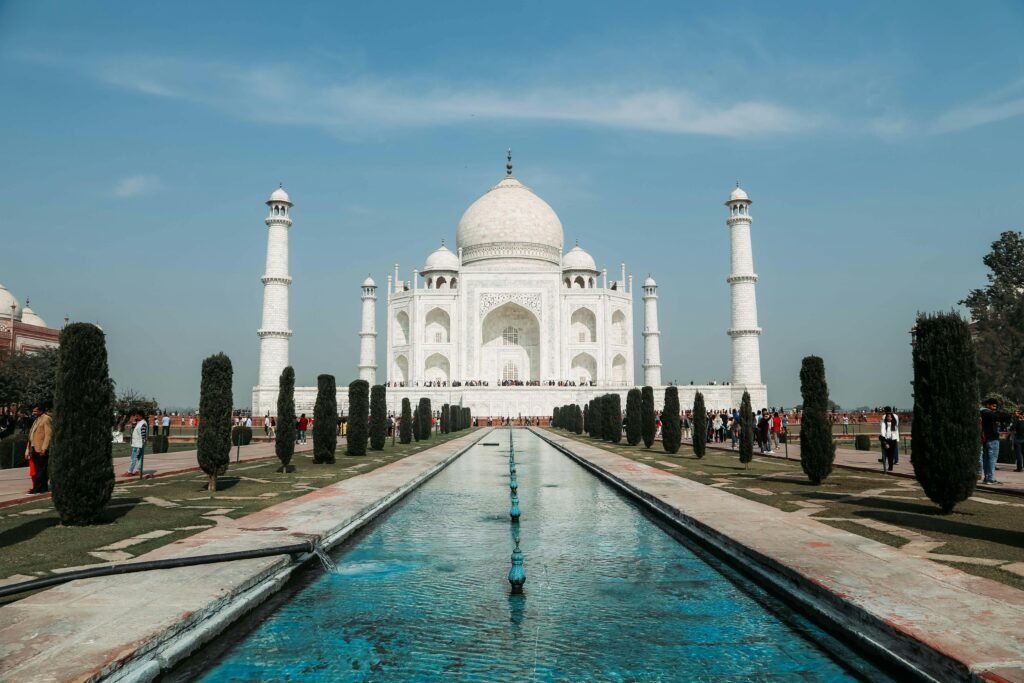
Set in a formal charbagh (quadrilateral garden) beside the river, the Taj blends Persian, Timurid and Indian design traditions. The central dome, four elegant minarets, perfect bilateral symmetry and meticulous optical refinements like the outward lean of the minarets and enlarging calligraphy that reads “correctly” from ground level create a visual harmony unmatched in world architecture.
Materials and Craft
The luminous façade is Makrana marble from Rajasthan, prized for its density and low porosity, overlaid with pietra dura (parchin kari) inlays of semi-precious stones forming vines, flowers and Qur’anic calligraphy. The craft lives on in Agra’s workshops run by descendants of Mughal artisans.
Fast Facts (What Most Visitors Ask)
- Opening hours & closure: The Taj opens roughly from sunrise to sunset and is closed on Fridays for prayers. Ticket windows at the East and West gates open one hour before sunrise; the South gate is exit-only.
- Night viewing: Limited night visits run on the full-moon evening and two nights either side (except Fridays and during Ramadan), in timed batches of 50 for 30 minutes each. Book ahead.
- Photography rules: Photos are not allowed inside the main mausoleum; drones and tripods are prohibited across the complex.
- Green zone & shuttles: No polluting vehicles are allowed within 500 metres of the Taj; park at Shilpgram (East Gate) or Amrood-ka-Teela (West Gate) and use the battery bus/golf carts.
- Accessibility: Ramps take wheelchair users to the marble terrace; free wheelchairs are issued by ASI (deposit may apply). The inner chamber has steps. Shoe covers are provided/required on the marble platform.
Planning Your Visit
Best time of year, best time of day
Northern India’s winters can be foggy, and summers sweltering. For light, comfort and manageable crowds, aim for mid-September to October or March. Within the day, sunrise and late-afternoon into sunset offer the gentlest light and (typically) fewer tour groups. If you’re lucky to be in town for a full moon, the special night viewing is a bucket-list add-on.
Getting there (from India and the UK)
- From Delhi (by rail): The Gatimaan Express links Delhi’s Hazrat Nizamuddin with Agra Cantt in about 1 hour 40 minutes, six days a week (not Friday). From Agra Cantt, it’s a 20–30-minute transfer to the Taj East or West gates.
- From Delhi (by road): The six-lane Yamuna Expressway runs 165.5 km to Agra; typical driving time is about four hours, with posted speed limits of 100 km/h for light vehicles.
- From the UK: There are frequent non-stops from London to Delhi on major carriers; connect onward by train or car as above.
On arrival: gates, tickets, and what to bring
- Gates: Use East Gate (quieter in early morning) or West Gate (often busier with tour buses). The South Gate is exit-only.
- Tickets: Buy online via the official ASI portals or onsite (carry photo ID). Night-viewing tickets must be reserved in advance.
- What to carry: Keep it light, water (< 0.5L), phone, small camera, and minimal personal items. Shoe covers are issued/checked before the marble terrace/mausoleum. Drones, tripods, tobacco and food are not permitted.
Family, couples & solo tips
- Families: Strollers are easiest in the gardens; the mausoleum has stairs, so a carrier helps. Pack snacks for before/after your visit – food isn’t allowed inside.
- Couples: Time your entry for first light or late afternoon; linger in the forecourt gardens as the marble warms through pinks and golds.
- Solo travellers: Consider night viewing or a sunrise session across the river at Mehtab Bagh/Taj Viewpoint for contemplative shots with fewer people.
Inside the Complex: What Not to Miss
- The Great Gate (Darwaza-i-Rauza): Framing the first “reveal”, its red sandstone contrasts beautifully with the marble beyond.
- Reflecting pool axis: The classic postcard view – revisit as the light shifts.
- The Mausoleum: Appreciate the pietra dura, jali screens, and calligraphy up close – no photography inside, so soak it in.
- Mosque & jawab: Step to the jawab (guest pavilion) for softer side-light and quieter corners.
- Taj Museum: A small trove of drawings and artefacts, typically open 10:00–17:00.
Practicalities That Make the Day Smoother
- Eco-shuttles: From Shilpgram or Amrood-ka-Teela parking, hop on a battery bus or golf cart to the gates. Foreign visitor tickets include shuttle use; otherwise, pay a small supplemental fare.
- Security: Expect airline-style screening. Avoid bringing large bags or electronics beyond cameras/phones.
- Footwear: Shoe covers are provided/checked for the marble terrace; you may remove shoes instead (hot underfoot in summer).
- Guides & scams: Hire only ASI-approved guides/photographers with visible ID; ignore anyone claiming “the Taj is closed today”.
Beyond the Taj: Agra in a Day (or Two)
Agra rewards anyone who lingers. Here’s how to weave its Mughal masterpieces and neighbourhood flavours into an elegant plan.
Classic One-Day Agra (Families & First-timers)
06:00 – 08:30 | Taj Mahal (East Gate)
Arrive for the hush and pastel light. Work the main axis, then slip to the mosque side for gentle side-lit portraits.
09:00 – 10:00 | Breakfast break
Head back to your hotel or a nearby café.
10:30 – 12:00 | Agra Fort
A UNESCO site in its own right, Shah Jahan’s later years unfolded here under Aurangzeb’s house arrest. (Tickets sold separately.)
12:30 – 13:30 | Lunch
Consider Pinch of Spice for a relaxed Mughlai spread that suits mixed tastes.
14:00 – 15:00 | Itmad-ud-Daulah (Baby Taj)
A jewel-box tomb that prefigures the Taj; crowd-light, detail-rich, easy with kids. (Open sunrise to sunset.)
16:00 – Sunset | Mehtab Bagh / Taj Viewpoint
Finish across the river with the Taj glowing at golden hour; superb for family photos.
Two–Three-Day Golden Triangle Loop (Couples & Culture Lovers)
Day 1 | Delhi → Agra
Take the Gatimaan Express (≈1h40). Check in, then visit Agra Fort and Mehtab Bagh for sunset. Dine at Peshawri (tandoor classics) or Infini – The Sky Lounge for rooftop views.
Day 2 | Taj at Dawn + Fatehpur Sikri
Return at sunrise for the Taj; after breakfast, drive ~37 km west to Emperor Akbar’s abandoned Mughal capital Fatehpur Sikri (allow at least half a day).
Day 3 | Agra → Jaipur
Continue to Jaipur (roughly 240 km / 4–5 hours) via Bharatpur—add a birdwatching stop at the Keoladeo sanctuary if you’re keen.
Solo Heritage Ramble (Add-Ons)
- Akbar’s Tomb, Sikandra: A serene complex of red sandstone and white marble north-west of Agra.
- Kinari Bazaar: Lanes of zari trimmings, marigold garlands and sweet shops for an atmospheric wander (ideally with a local guide).
Seasonal Moments & Special Experiences
- Taj Mahotsav (Feb/March): A 10-day festival of crafts, dance and music at Shilpgram near the East Gate – great for families and culture seekers. 2025 dates: 18 Feb–2 Mar.
- Full-moon viewing: A rare, serene perspective from the forecourt, with tickets capped and timed. Book early; check that it doesn’t fall on a Friday or during Ramadan.
- Agra Metro (rolling out): A new Taj East Gate corridor improves city mobility; a priority stretch is already running, with more to come in 2025–26.
Where to Eat & Stay (Balanced Picks)
Dining
- Esphahan (The Oberoi Amarvilas): Date-night dining with North Indian classics and candlelit ambience.
- Peshawri (ITC Mughal): Frontier-style grills—share the dal and breads; bookings advised.
- Pinch of Spice: A reliable local favourite for families and groups.
- Sheroes Hangout: A social-enterprise café run by acid-attack survivors – stop for chai and to support an important cause.
Stays
- The Oberoi Amarvilas (luxury): Every room is oriented to the Taj – unrivalled for couples seeking a splurge.
- ITC Mughal, a Luxury Collection Resort & Spa (upper-mid): Vast Mughal-style gardens, spa and multiple restaurants – easy with kids.
- Trident, Agra (mid): Friendly, efficient and a short hop to the East Gate.
- Hostels & budget stays: Look near Tajganj or around the East Gate for walkable access and roof-terrace cafés.
Responsible & Respectful Visiting
- Dress and conduct: The mausoleum is an active sacred space. Dress modestly, speak quietly, and follow stewards’ guidance.
- Leave no trace: Use bins; don’t touch the inlay work.
- Support local craft: If buying marble-inlay souvenirs, seek reputable workshops; beware “Makrana marble” claims at suspiciously low prices.
Wider Connections: How the Taj Mahal Speaks to UK Travel
Britain’s long fascination with South Asian aesthetics is writ large in the Royal Pavilion at Brighton – an Indo-Saracenic fantasy of domes and minarets and Sezincote House in the Cotswolds, an early 19th-century country house consciously styled on Mughal forms. Both make rewarding follow-ups back home if the Taj has sparked an interest in Indo-Islamic architecture. The V&A and other UK museums also hold Mughal art (including pietra dura panels), opening further avenues into the design language you’ll have admired in Agra.
For travellers crafting multi-country, culture-first itineraries, consider pairing India’s Mughal masterpieces with the UK’s own UNESCO heritage – Blenheim Palace, Westminster Abbey, Edinburgh’s Old & New Towns to compare how different empires expressed power, piety and prestige in stone.
Photography Playbook (Within the Rules)
- Golden spots: The central axis at dawn; the mosque side for angled light; the jawab for people-free frames; Mehtab Bagh/Taj Viewpoint for silhouettes and river reflections.
- Gear: A mid-range zoom or two primes (wide + portrait). Tripods and drones are banned; pack a lightweight beanbag if you need support. No photos inside the mausoleum.
- Etiquette: Move aside quickly at the central bench, avoid blocking views, and resist “twirl” shots on the marble terrace (wardens will stop you).
Accessibility Snapshot
Wheelchair users can navigate the gardens and reach the chameli-farsh (marble terrace) via ramps at the East/West sides; free wheelchairs are available from ASI on request (carry ID for deposit). Steps prevent access into the inner chamber, but views from the doorway are still powerful. Accessible toilets are limited; plan comfort breaks accordingly.
Two Ready-to-Roll Itineraries
1) One Perfect Day in Agra (≈15 km, gentle pace)
Sunrise (2–2.5 hrs) – Taj Mahal via East Gate.
Late Morning (1.5–2 hrs) – Agra Fort’s palaces and river views.
Lunch (1 hr) – Pinch of Spice (family-friendly).
Afternoon (1 hr) – Itmad-ud-Daulah (Baby Taj).
Sunset (1–1.5 hrs) – Mehtab Bagh/Taj Viewpoint across the Yamuna.
Why it works: Minimal backtracking, each stop adds a layer of refinement (Taj), power (Fort), intimacy (Baby Taj), and reflection (Mehtab).
2) The Classic Golden Triangle (3 days by rail/road)
Day 1 – Delhi → Agra
Morning Gatimaan Express; afternoon Agra Fort; sunset at Mehtab; dinner at Peshawri or a rooftop lounge.
Day 2 – Taj at Dawn + Fatehpur Sikri
Early Taj session; brunch; drive 37 km to Fatehpur Sikri (allow 3–4 hours on site).
Day 3 – Agra → Jaipur
Road transfer roughly 240 km / 4–5 hours via NH21; add a detour to Keoladeo National Park if nature’s your thing.
Final Thoughts
Arrive early (or late), travel light, respect the rules, and allow yourself a few unhurried minutes simply to sit in the garden and look. The Taj rewards stillness: the longer you give it, the more the stone seems to soften, the geometry to breathe, and the story to come into focus.